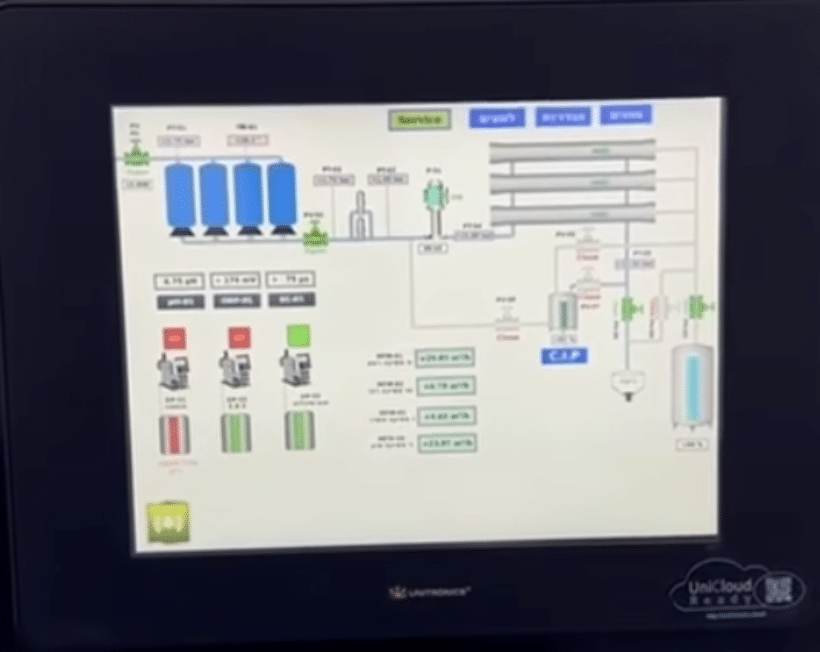
Supplying consistent, high-quality water to a remote dairy facility presents a complex control challenge—especially when the only available source is high-salinity well water. YWT addressed this by deploying a UniStream® Cloud-Inside controller to manage the entire RO process in a single, integrated platform. Through precise pressure regulation, flow-based chemical dosing, intelligent interlocks, and automated Cleaning-In-Place (CIP) cycles, the system ensures continuous operation and protects membrane performance, while its architecture lays the foundation for predictive maintenance and full remote visibility via UniCloud.
YWT specializes in the design, integration, and lifecycle support of advanced water-treatment and Reverse Osmosis (RO) systems for industrial and commercial applications. They deliver turnkey solutions—ranging from process engineering to system commissioning—ensuring the reliable production of high-quality water under demanding operating conditions. With a focus on automation, YWT enables customers to reduce operating costs and maintain consistent water quality throughout the system’s life.
The end-user is a large dairy facility located in the desert. In this arid climate, water is a critical resource required for three distinct production needs:
The best available water source is local well water, which has a high degree of salinity. To make this water usable, it must undergo desalination via Reverse Osmosis—a process where high pressure forces water through semi-permeable membranes to remove salts and contaminants.
The challenge was to design a control system capable of managing the high pressures and precise chemical balances required for RO, while ensuring maximum uptime in a remote location where physical service visits are scheduled only once every two weeks.
YWT selected the Unitronics UniStream Built-in 10 (PLC + HMI) to control the entire physico-chemical process.
The system manages the plant flow: Pre-filtration → Reverse Osmosis → Product Tank.
The UniStream was chosen for its robust communication capabilities and its “Cloud-Inside” architecture. YWT designed the system not just for current control, but for future scalability using UniCloud. This forward-thinking approach allows the controller to bridge the gap between physical site operations and remote service teams.
The UniStream PLC serves as the brain of the desalination plant, executing a fully interlocked, closed-loop control strategy.
The RO process requires overcoming osmotic pressure to force water through membranes. The UniStream controls a high-pressure pump via a 3rd-party VFD communicating over TCP/IP. This ensures the precise pressure regulation that is essential for membrane health.
To protect the membranes from fouling and scaling, the PLC controls three chemical dosing pumps. These inject sodium bisulfite and anti-scalants based on real-time flow and water chemistry data.
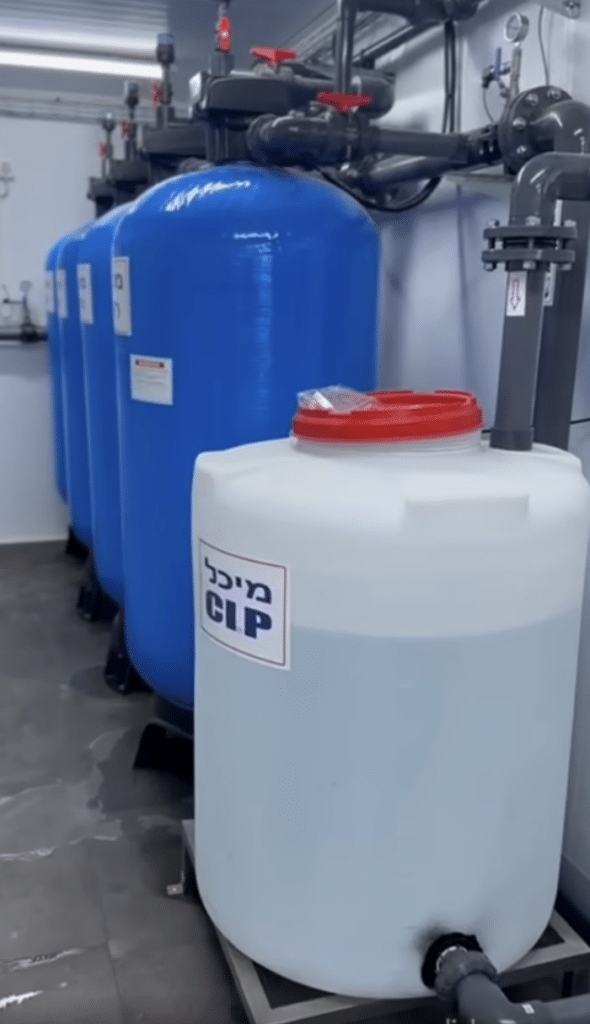
One of the system’s most advanced features is the automated CIP sequence. Instead of dismantling equipment for cleaning, the UniStream executes a maintenance cycle that:
This repeatable, automated procedure preserves membrane efficiency without requiring manual intervention from the dairy staff.
The system monitors critical parameters including pressure, flow, conductivity, and tank levels.
The installation has transformed a saline water source into a reliable utility for the dairy, delivering several key benefits:
By consolidating control, diagnostics, and HMI into a single UniStream platform, YWT created an RO system that is both operationally robust and maintenance-efficient. The combination of interlocked process control, automated CIP, and remote performance visibility reduces unplanned downtime and protects membrane life while supporting consistent dairy production. With the system already designed for full UniCloud integration, the plant is positioned to move from reactive service to predictive maintenance—ensuring reliable, high-quality water supply as demand grows.
“The real value of UniStream is the level of control and visibility it gives us. We can see exactly what’s happening in the system at any moment, and so can the customer. That closes the gap between the site and the service team—maintenance becomes planned instead of reactive, and decisions are based on real data.”